
Mobile app monetisation, via popular monetisation business models like in-app purchases, in-app ads, freemium or paid downloads, is one of the top goals of publishers regardless of their type and scale. In 2014, the mobile app ecosystem saw record numbers such as 138 billion app store downloads and $35 billion in revenue. The wave towards mobile continues and is building momentum.
Amongst the different app monetisation business models, in-app advertising continues to grow and is being adopted by more publishers to reach their monetisation goals. With the unprecedented increase in smartphone adoption and the increasing amount of time people now spend on their phones, it is only natural for mobile advertising to take flight as well.
And it has.
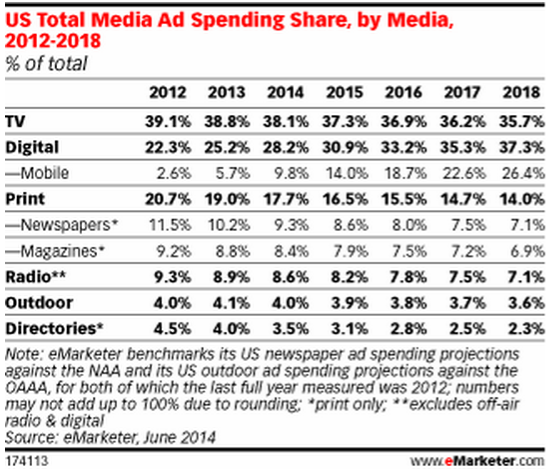
According to eMarketer, last year mobile represented nearly 10% of all media ad spending, surpassing newspapers, magazines and radio for the first time to become the third-largest individual advertising venue, only trailing TV and desktops/laptops.
Two popular technologies for facilitating in-app advertisements are RTB and mediation.
Let us look at the each of these channels in detail:
RTB (Real Time Bidding): In the simplest terms, RTB is a technology that automates the buying and selling of ads in real time. It enables advertisers to evaluate each and every impression and bid on it accordingly, all in a matter of mille seconds. RTB platforms use various algorithms to reach users in real time based on their demographics, location and context.
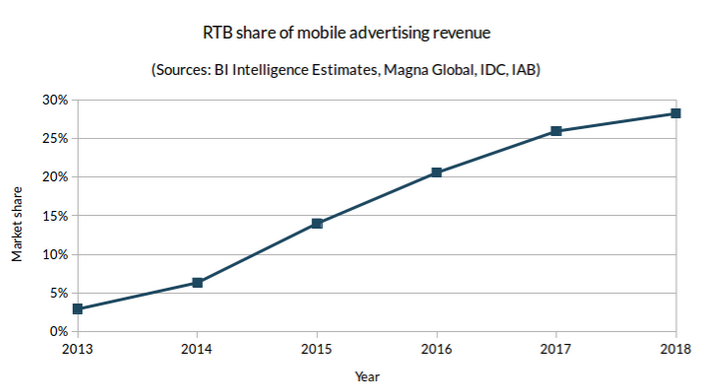
RTB entered the mobile advertising space sometime around 2009. RTB adoption has been slowly but steadily increasing over the past few years. It is only recently that the RTB adoption has taken flight. A recent article by Business Insider showed that the RTB share in mobile advertising would grow from 3% in 2003 to 30% in 2018.
Ad Mediation: Ad mediation companies are essentially ad tracking platforms that connect to multiple ad networks maximising fill rates and boosting publisher revenue. Ad mediation companies make it easier for publishers to monetise their apps as they take the hard decisions of choosing the best ad network and optimising their ad inventory away from the publisher. This way, publishers who have little or no knowledge about ad networks and ad
optimisation can safely rely on the mediation platform and get the maximum revenue out of the ads they are hosting on their apps.
Drawbacks of RTB and Mediation
Mobile advertising is still in a nascent stage and it is yet to be seen which monetisation method is here to stay. While both, RTB and mediation have their own advantages, they face the following two main challenges that limit their reach, adoption and performance:
1. Lack of holistic audience data at the publisher’s end: Data is key in RTB. It is with data that RTB becomes effective. Most mobile RTB platforms have access to some user data information such as location, gender and in some cases, context. However, due to the issue of limited reach of cookies in mobile, it is extremely difficult to get a holistic audience profile and often publishers have very little data on who their users really are. If publishers get access to rich user data then that would completely change the RTB and mediation landscape as having that user data would help publishers understand the value of their inventory.
2. Data leakage and privacy: One of the big challenges that RTB faces is the potential of data leakage where user data can flow out of the system. With more and more people using smartphones today, there is a staggering amount of personal data being shared daily. Data privacy is a big concern today and most RTB platforms do not guarantee the safeguarding of mobile users’ personal data.
The RTB and mediation adoption is now increasing at a fast rate and if they can overcome the challenges mentioned above, the mobile advertising space will see unprecedented change. While these methods have shown promise in the short term but the long-term value of solely using these methods is yet to be seen. Publishers need to have a more holistic advertising strategy in place and should instead look at companies that provide a more holistic service by combining one or more of mobile advertising methods.
Introducing Real time mediation
What if someone could combine the features of real time bidding and ad mediation into one robust product with ad targeting capabilities like never before thereby increasing revenue for publishers?
Too good to be true? Not really.
There are some innovative companies like Personagraph, Smaato and OpenX that are redefining the mobile advertising space by coming up with a path breaking solution, which combines real time bidding with ad mediation.
What’s in it for the publishers?
The benefits to publishers for using an innovative monetise solution that combines the features and functionality of RTB and mediation include:
1. Increased value of publisher inventory: Most publishers don’t know the true value of their inventory, meaning they don’t know much more they could get from advertisers if the advertisers had more in depth data on the impressions they are buying. The bottomline is that each mobile user is unique with different sets of interests, demographics and intents and that advertisers would be willing to pay more if they knew what audiences they were buying. With the help of real time mediation, publishers and advertisers alike would have a more holistic view of the mobile users thereby increasing the overall value of the inventory.
2. Higher fill rates: The way ad mediation platforms work is, they are connected to hundreds of ad networks at the API level. Ad mediation platforms rank all the ad networks based on some preference. When the mediation platform gets an ad call, it first sends it to the top ranked ad network. If this network cannot fill the ad request, it then goes to the second ranked ad network and so on. The ad request “waterfalls” down the ad network chain until it gets filled. All this happens in a matter of milliseconds. This kind of waterfall model ensures that publishers get high fill rates for their ad requests.
3. Increased revenue: App monetisation in the end is a money game. Most publishers want to make good money from their app and are always on the lookout for companies that will help them do so. One of the hardest decisions that app developers have to make is choosing the right ad network/exchange that will help them maximise the amount of revenue they will make. Choosing ad mediation platforms makes that decision easier as they are known to generate higher revenues for publishers due to their sheer reach alone.
4. Hassle free and hands on service: Real time mediation makes it easy and convenient for publishers as they have to integrate just one SDK to instantly get connected to all the different ad networks and exchanges. Real time mediation companies provide seamless ad network and ad operations management, thus doing the heavy lifting for the publishers.
Real time mediation is a relatively new concept and the different players in the mobile ad tech space are just starting to take notice and realise its importance. Real time mediation companies can provide effective targeting for advertisers, higher revenue for publishers and data privacy for the mobile users.
By Shruti Lele, Personagraph.
PrivSec Conferences will bring together leading speakers and experts from privacy and security to deliver compelling content via solo presentations, panel discussions, debates, roundtables and workshops.
For more information on upcoming events, visit the website.
comments powered by Disqus