
No one would argue that digital has changed the way that we operate as marketers. We’ve had to take on a whole new skill set, learn a new language of clicks, shares and gifs, and battle with the frustration that data doesn’t necessarily bring the insight we crave. For the last 5 years, we have been studying What Works Where in B2B digital marketing, and despite the increased visibility of people’s online behaviour, in 2014 the report showed that only 16% of marketers were confident in their ROI.
The 2015 report ‘The Recipe for Digital Success’ highlighted that in fact the changes go beyond the marketing department and are now transforming the way in which the whole organisation communicates. Based on 330 respondents from Marketing, Sales, Customer Service, HR and Internal Communications, the survey demonstrates that digital has enabled every department to communicate easily, frequently and equally well. Every department is spending a considerable proportion of their communications budget on digital communications, 54% on average. The result is that of the £160m being spent on communications by respondents, just 52% was under the control of marketing. And other departments are communicating more frequently with customers too. It turns out that customers are 30% more likely to hear from someone else in the organisation than from Marketing. So not only is marketing no longer the sole ‘communications’ department, it would seem that we have also lost control of the customer experience.
This democratised landscape is echoed in the finding that people do not evaluate marketing’s ability to communicate any higher than any other departments. When respondents were asked how effective each department or team was in communicating with its main audience, Marketing scored 20% for ‘very effective’, only 1% higher than IT, and behind HR, Sales and Customer Service by a few percentage points.
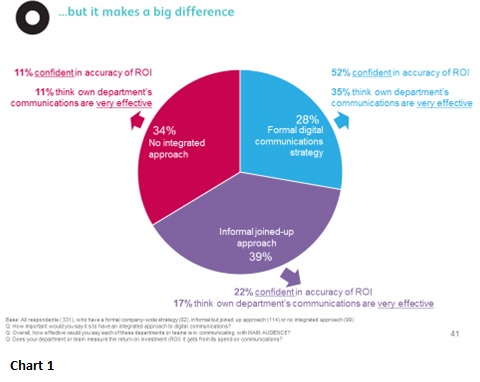
In light of these findings, it might be logical to think that organisations no longer need a joined up approach. But in fact, the research shows that the majority of people, in all departments, recognise that an overarching digital strategy is either important or critical. And, whilst only 28% of organisations surveyed had one, they were dramatically more likely to be confident in effectiveness of their communications and in the ROI. 56% of respondents feel confident in their ROI for organisations with a digital strategy vs only 11% without one. See Chart 1.
Something is clearly working for this group, so the research also looked for the things that both hindered and enabled the creation of a digital strategy. Interestingly it’s these that give a hint on how marketing might need to recalibrate. See Chart 2.
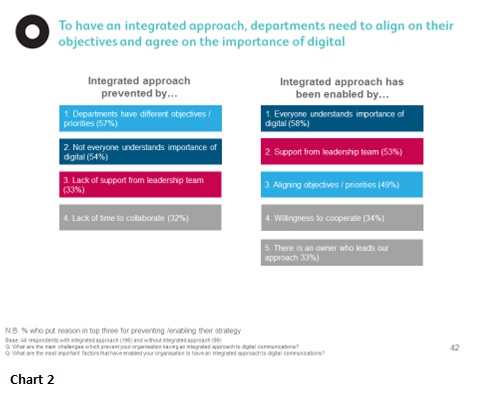
First, everyone needs to understand digital. At 58% this is the top enabler required to get a strategy in place. Marketers can be central to this. Not simply by being digital experts themselves, but also being seen as the source of information about what it does for the organisation and how do to it well.
Second, support is needed from the leadership team, according to 53% of respondents. So marketers need to make strong connections internally to make the case for digital. Educating senior management could be central to this, as they are often the audience that understands digital the least.
Next, building internal relationships will help align objectives and priorities and encourage people to cooperate. Unless people understand what the brand stands for and what the company is expert in, it will be unlikely that they will be able to articulate it in their interactions with customers.
Finally, digital needs a leader. But when respondents were asked which department should be in charge of the digital strategy, Marketing did not come top of the poll. 88% of marketers believe they should lead on digital strategy, but only 23% of other departments agreed. HR and IT are both credible leaders in a world where business success relies on both people and platforms. Without ownership of either, Marketing can find itself only on the edges of digital strategy.
Addressing this lies in the previous actions, being the digital expert and building internal relationships. But finally though, it’s about owning the customer experience and understanding how digital impacts on it. At that point, the changes digital has imposed on the marketing function will propel us back into the centre of the conversation.
By Fran Brosan, Chairman and co-founder at Omobono.
PrivSec Conferences will bring together leading speakers and experts from privacy and security to deliver compelling content via solo presentations, panel discussions, debates, roundtables and workshops.
For more information on upcoming events, visit the website.
comments powered by Disqus