
Fragmentation in marketing channels is a barrier to delivering on brand promise. For example, research by Monotype’s Brand Perfect initiative, found that 62%* of consumers in the UK and US prefer dealing with native digital retailers rather than traditional ‘High Street’ ones, largely due to inconsistency in the service that traditional retailers are offering between in-store, the desktop and mobile.
This inconsistency is caused by varied technologies, the lack of standards and tools. But while we all catch up with technology, our customers have already moved to the web, which they access via increasingly disparate mobile platforms – not just smartphones, but tablets and, increasingly, ‘Smart’ TV too.
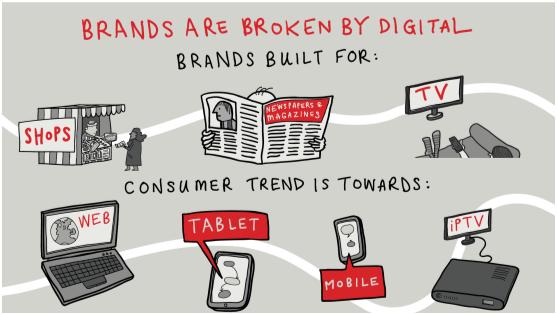
This broken experience is also happening because the branding process itself is fragmented. Specialists in different disciplines have, well, specialised too much.
Examine the workflow involved in creating a new brand**.
The first part is probably familiar to you – the journey starts with the brand forming a brief for an agency and a range of marketing and product stakeholders involved brand side.
But then the agency takes on the brief, and look what happens – the brand and marketing people are out of the picture and it’s the product manager who is now the point person. Until this stage there’s not been a developer in sight.
Now that we’re talking about building our experience, the developers enter the process. It’s is only at this point we discover that our big idea just isn’t feasible technically.
Over half of the 600 companies surveyed*** reported a reduction in project profitability and almost half have been late to market working this way.
So how do we build seamless brands…
1. Unite your marketing, design and development teams, internally and externally; share and test ideas from concept to completion.
2. Be where your customer is – find this out first. Design your brand taking all touch points into consideration, not only print.
3. Imagine contextually appropriate experiences that are unified, whole, continuous, unbroken, flowing, from platform to platform for the customer. But – and here’s the important bit – not all the same or based solely on the print or desktop assets.
4. Are you reading me? Ensure the most fundamental ingredients such as text actually perform for your customer.
5. Test, test, test. Build a realistic development budget and time into your plan to ensure what you build works for your customer. Rapidly prototype rather than detail design initially.
6. As web standards based on HTML5 mature, it will become easier for brands and publishers to place themselves back in the hands of consumers. HTML5 works across the big four platforms of PC, tablet, smartphone and smart TV, so experiences can be created more consistently.
7. Finally, seamless brand experiences are not about replicating the same campaign at every touch point. But there should be some fluidity and connection between touch points for the customer. So it’s clear that they are dealing with you. If they don’t trust what they see they won’t respond.
Sources:
* Brand Perfect Adventures In Retail Study by Opinion Matters for Monotype, November 2012
**Brand Perfect research conducted by Fjord, focus group study, December 2011
*** Brand Perfect Research conducted with ORB Research commissioned by Monotype in April 2011
By Julie Strawson, Director of Marketing and Market Development, Monotype Imaging and partner of brandperfect.org.
PrivSec Conferences will bring together leading speakers and experts from privacy and security to deliver compelling content via solo presentations, panel discussions, debates, roundtables and workshops.
For more information on upcoming events, visit the website.
comments powered by Disqus