
With 30M followers on Twitter, 25M on Facebook and 28M on Instagram, Kim Kardashian has cultivated a combined audience that is greater than the UK population. Whatever your feelings might be on the reality TV star, it’s tough to deny that she has built a social media empire. So in February, when she quietly announced a project that would shift her marketing focus away from those social networks, it got my attention.
The entire Kardashian family, along with Howard Stern and others, have partnered with technology company Whalerock Industries to take their social presence into their own hands by building independent social media hubs.
Kim’s hub, for example, will include everything from photos and videos to makeup tutorials and city guides. The benefit here is clear. By creating a central destination for their fan base to discuss all things Kardashian or otherwise on their websites and mobile apps, these celebrities are taking their content, data and resulting profits into their own hands — vs. letting a third party like Facebook or Twitter monetise their image.
“I see what we do on social media as the appetizer,” Khloe Kardashian told the New York Times. “This is the whole dinner. Not everything we do can be captured in an Instagram shot.” Kim added, “This isn’t about doing another website. It’s about creating a digital destination.”
Regardless of whether you’re willing to call her a marketing expert, Kim’s point echoes the words and actions of industry analysts and brand marketers over the past several months.
Marketing pundit Michael Hyatt, Forrester digital marketing analyst Nate Elliott, and marketing executives from Dell, and Taco Bell have all preached a similar shift in their social media marketing strategies.
When you consider how the social media landscape has evolved over the past year, it’s easy to see why marketers are making these changes. Take a look at the charts below. According to this data from Forrester research, maintaining branded social profiles remains the most popular social media marketing tactic… but it’s also among the least effective.
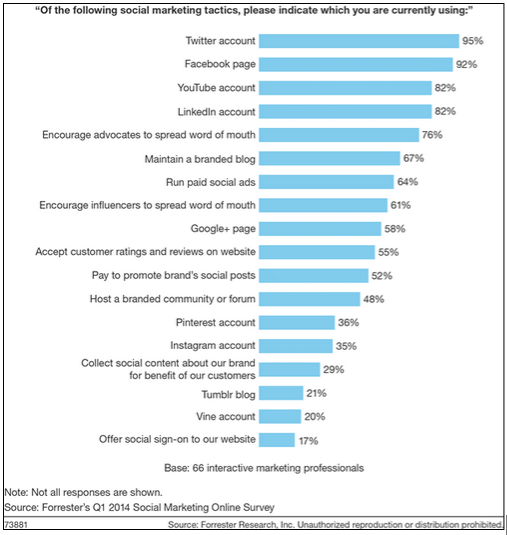

Now look at the tactics that marketers say offer more value: email marketing, ratings & reviews, search, branded communities and word of mouth — all channels that you can optimise by investing in your owned properties.
Instead of spending all your digital marketing dollars to engage the same audience over and over on Facebook, Twitter or Pinterest, use those sponsored posts to drive your audience to your owned properties. And when they arrive, greet them with a universe of content they love. Exactly what that universe looks like is up to you and it depends on what unique values your brand shares with your audience.
Here’s how to get there:
1. Find those shared values. Ask yourself, “Outside of my brand, what else does my audience care about?” and then “Does (or should) my brand care about that, too?”
Global Bank HSBC was looking to target young consumers with the relaunch of the HSBC Advance bank account. They wanted to humanise banking by focusing on this young group’s financial aspirations and a community that could help them to achieve their goals. To do this, they created a number of documentary style videos profiling real stories of consumers who achieved their goals with the help of a support network, and curated the content in real-time into a Social Hub on the HSBC Advance website. Here, users were invited to create their own ‘thank you’ films to send to those who have helped them along the way, and share these films and thank you messages with others on the site.
2. Define a clear objective. A surprising number of marketers mistakenly confuse objectives with metrics. If you want to be truly effective, you need to think bigger than driving traffic or shares (metrics) and determine why you want to drive that traffic or earn those shares.
What’s the real objective? Increasing sales? Gathering email addresses? Building brand affinity? By identifying and understanding the big picture, you can think more holistically about how to drive user behavior.
So instead of just driving traffic to a cool microsite, you can also gather email addresses by asking visitors to register for exclusive content, or drive product exploration through user reviews and photo uploads.
3. Start small. You don’t have to redesign your entire website all at once, and you probably shouldn’t. Instead, find places where community is already thriving on your website or your app.
How can you enhance that experience to offer more value for the fans who are visiting? What additional context would help those users better connect with each other, with your brand or with the product?
There’s no magic formula that you can use across all of your digital properties, but the right combination can make a huge impact on the way your audience engages with your brand.
The audience you built on social networks like Facebook and Twitter likely took a fair amount of time and investment. Building a long-term audience on your own site is no different. However the payoff is worth it… gaming site IGN found that logged-in users who engage with their content view 10X more pages and 6X more videos than regular visitors. While it does take a thoughtful strategy and dedicated community management resources, engaging your audience on a property that you control, where you own the experience, the content and the data, is well worth the effort.
By Jordan Kretchmer, Founder and CEO of Livefyre.
PrivSec Conferences will bring together leading speakers and experts from privacy and security to deliver compelling content via solo presentations, panel discussions, debates, roundtables and workshops.
For more information on upcoming events, visit the website.
comments powered by Disqus