
Spelling and search have a long and complicated history. As little as four years ago, SEOs were arguing that sites should target misspellings, since they accounted for a significant amount of search traffic. Indeed, Google's own statistics bear this out: something like 10-20% of Google searches are misspelled. Given there are over 3.5 billion Google searches every day, there are around 350-700 million misspelled searches each day.
Four years might as well be four decades, as far as SEO is concerned, and now all the major search engines work to correct spellings and return the best results for the intended search term, rather than the one that was typed into the search box.
Google in particular is getting much more sophisticated about how it returns misspellings. It has three spell checking tools to help return the correctly spelled results (called Did You Mean, Chameleon and Spellmeleon), and they're getting more effective every day.
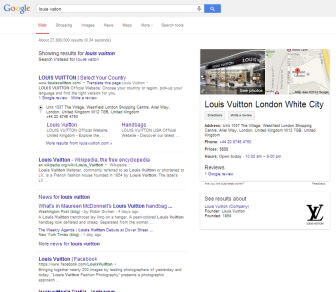
That's why a Google search for "louie vaton" returns this:
Moreover, Bing has confirmed that they use proper spelling and grammar as a ranking factor, and Google's Matt Cutts said that while they didn't use spelling as a direct signal for rankings, good spelling strongly correlated with higher ranking sites. In other words, proper spelling goes hand in hand with strong rankings on the major search engines.
So good search rankings are strongly correlated with good spelling. Search engines are getting ever better at spotting misspellings and returning the properly spelled results. And hundreds of millions of searches are misspelled every day.
With all of the above findings in mind, how then can one leverage spelling mistakes to improve your search rankings and lower your PPC costs?
More to the point, why should you bother?
How spelling mistakes can lower your PPC costs
The short answer to the why is this: because right now, it still works. With PPC, you can target a number of misspelled words more effectively than you can their correctly spelled counterparts. Misspellings get lower search volumes, so the cost and competition for misspelled words is often lower.
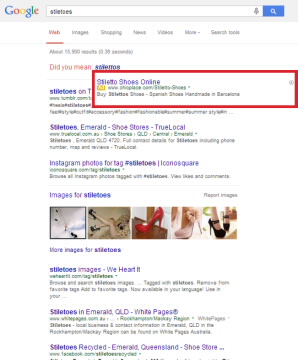
Take, for example, a search for "stiletoes". There are enough pages online to prevent Google from automatically showing the correct spelling, "stilettos". And down at the bottom of the page, there is an AdWords ad that shows up in the misspelled results, but not in the correctly spelled results.
While the above example shows how ordinary companies can target misspellings in PPC, Snickers took it to another level. They decided to buy AdWords ads for 25,000 misspellings and typos. Then, when people searched for those misspellings, they saw a sponsored ad that took them to yourenotyouwhenyourehungry.com, a Snickers microsite.
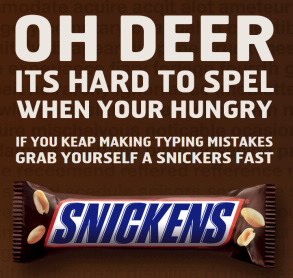
Snickers claimed to have received visits from 500,000 searchers, but they also got some big online PR wins, gaining coverage on Mashable and Search Engine Watch, amongst many others.
How spelling mistakes can boost your SEO strategy
There are also still some spelling mistakes that are worth targeting through SEO. You just have to dig around a little to find them. Using SEOBook's Keyword Typo Generator to find misspellings of sweatshirt, we discovered some interesting results for "weatshirt". Clearly, there are some e-retailers targeting this misspelled word.

One site created a targeted PDF, while another page is just a computer-generated category based on user tags. Finally, there is another that included the misspelled word in the page's title tag and meta description. Each method is demonstrably effective, at least in this particular example.
Of course, as in the Snickers example, some companies are having some SEO-based fun with search-based spelling mistakes. Bathrooms.com did this recently, after noticing that la large amount of Brits search for "bathroom sweets" instead of "bathroom suites". They created a microsite – BathroomSweets.com – to draw searchers' attention to their spelling mistake, and then they took it a step further. They teamed up with Brighton-based chocolatiers Choccywoccydoodah to allow people to order full-sized bathroom furniture or the full-sized bathroom suite, made entirely out of chocolate.

But you shouldn't take it too far
Frankly, targeting a misspelled term like this is just a little trick, an attempt to target mistakes, rather than legitimate results. As such, it has a limited shelf life, and it also carries some significant risks.
After all, customer trust melts away when misspelled words are prominent on a page. One website owner, Charles Duncombe, discovered that a site's revenue doubled once a very large typo was corrected. Many experts agree that it is a problem of perception: if a company doesn't care enough about their main sales pitch (the website) to make sure it's perfect, then how much will they care about their products, service or customers? But rampant misspelling also acts as a signal to users that a site may be spammy, shifty or downright predatory.
And the truth is, search engines are beginning to treat misspelled sites the same way. As mentioned above, Bing has already confirmed that they look for proper spelling, and Google admits there is a strong correlation between properly spelled sites and well-ranking ones. In all likelihood, as search engines get better at redirecting users to their intended spellings, pages featuring a lot of misspelled content are just going to get buried further and further down in the rankings.
By Adam Cassar, Digital Marketing Manager at Bathrooms.com.
PrivSec Conferences will bring together leading speakers and experts from privacy and security to deliver compelling content via solo presentations, panel discussions, debates, roundtables and workshops.
For more information on upcoming events, visit the website.
comments powered by Disqus