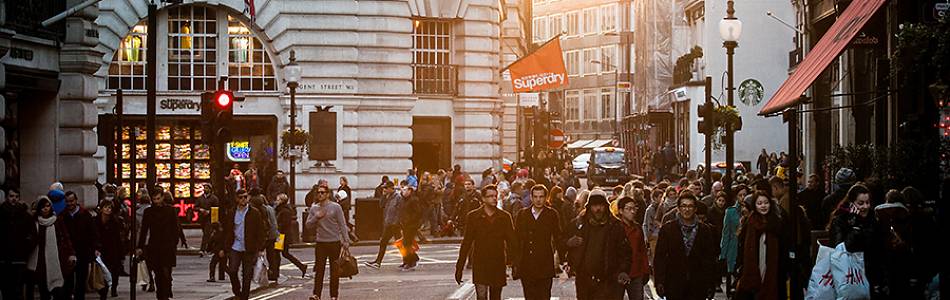
Last year, UK consumers spent (on average) a massive £718.7 million online every single week – an 11.8% increase compared to 2013 – yet, according to the Office of National Statistics, this represents just 11.2% of all retail spending. The vast majority, therefore, remains offline and the high street continues to sit in poll position. Admittedly this ratio does differ across industries – for example, 28.3% of all fashion sales last year took place online, and the percentage of groceries (12.9%) and general goods (28.8%) bought via the web were also above average. Yet in all cases, the high-street is still ahead.
So, with the vast majority of retail spending still being made offline, and store-based retailers taking the majority of sales, what is it that the high street has that hi-tech doesn’t?
Battle of the buyers: Online vs. offline
One of the key things bricks-and-mortar retailers have over their online counterparts, and vital for retaining their competitive edge, is the in-store experience. While we live in a world dominated by devices, sometimes all we want is good old fashioned human interaction – the value of going in-store to browse through rails of physical products (rather than search pages) shouldn’t be underestimated. It’s these elements of human service that online retailers lack, giving the high street the upper hand when it comes to sales.
Yet, this hasn’t gone unnoticed by retailers.
While high street stores are increasingly upping their technical game – introducing the best aspects of ecommerce to the physical shopping experience via new (and in some cases outlandish) in-store technologies – the ecommerce market is well aware of the need to improve their offering to win customers online.
More and more we’re seeing brands actively seeking to replicate this in-store experience online, creating virtual stores for consumers to browse and incorporating tangible video content to showcase products as they would appear in-store.
Coming soon: The virtual high street
So, with this in mind, we expect to see a few bold trends emerging over the course of the next five years. By 2020, it’s very possible that our online retail environment will be vastly different to the one we know now. As ecommerce channels strive to provide consumers with the best of both worlds, the ‘virtual high street’ will become a reality.
What will this entail? Here’s what we can see on the horizon…
1. Forget online stores, full scale e-Malls will be the norm.
With individual ecommerce sites already replicating the in-store experience – creating a virtual, hands-on approach to browsing – over the next few years we will see the high street environment digitalised. Sites will group together to allow seamless browsing between stores, imitating the physical experience of walking through a shopping centre. Cue the birth of the eMall.
Take appliance specialists, AO.com, for example. This concept of ‘digital showrooming’ is already central to their customer experience, featuring videos that show items as they would appear on the shop floor or explain what customers need to do to prepare for the arrival of their new appliance, just as a sales assistant would in-store.
2. Today’s dressing room is tomorrow’s virtual catwalk.
You drop an item in your basket and the option ‘Try It On’ pops up. The next thing you see is a virtual you strutting their stuff, in the chosen item, down the catwalk. Through a mixture of video and graphic technology this could be the next step for digital content online.
We’re already seeing this type of interactive experience appearing on many online fashion sites like Net-a-Porter, where products are showcased on the catwalk for shoppers to see. Videos like this allow consumers to get as close to products as possible. These days, whether online or on the high street, customers want to see what an item looks like on, from different angles and paired with different accessories – for ecommerce sites, video is an essential enabler here, providing shoppers with that in-store, ‘try-it-on’ experience.
3. Need assistance? Holographic personal shoppers will be at your beck and call.
Appearing on your desktop, sending ‘virtual-time’ requests to your phone (imagine face-time 2.0) or popping out of your smart watch, we’ll all have our own personal shopper on hand, whenever we want. Primed and ready to answer more questions that you care to imagine – ‘Does this go with the shoes I bought last week?’, ‘How can I return these?’, ‘What shall I wear on Saturday night?’ –virtual personal shoppers will be the human touch ecommerce has been craving.
The recent introduction of the new one-to-one video service for Barclays customers just goes to show we’re already heading in this direction. The importance of providing personalised shopping experiences is growing and, where online can sometimes lack individuality, a service like this may begin to fill the gap. After all, as Barclay’s CEO, Steven Cooper, said, “Sometimes you just can’t beat face-to-face conversations,” – even if they are holographic.
So, as retail technology progresses and consumers continue to demand more from their online shopping experience, digital assets, such as video and interactive content, will become the enablers of the future virtual shopping world.
All that’s left to do is sit back and watch as these visions strive to become reality…
By Sue Thexton, Senior Vice President, EMEA at Brightcove.
PrivSec Conferences will bring together leading speakers and experts from privacy and security to deliver compelling content via solo presentations, panel discussions, debates, roundtables and workshops.
For more information on upcoming events, visit the website.
comments powered by Disqus