
Effective global eCommerce takes more than just translating your website into multiple languages, accepting different currencies and managing different shipping logistics. Brands must strike a careful balance between customising their messages and offerings to local markets while taking advantage of global scale. From increased focus on local customer insights to the rise of services-oriented eCommerce platforms, here are the six trends that will determine not just which brands are able to expand globally in 2015, but which ones will do so profitably.
1. Success will come from focus
Instead of trying to serve all segments in a new market, effective brand marketers will utilize data-driven insights to find and tailor the experience to their most valuable customers. Factors include:
- The continued rise and ubiquity of purposeful mobile commerce solutions that are integrated with an omni-channel offering with seamless integration to clienteling solutions
- The adoption of marketplaces and their integration into your branded experience
- The need for supply chain optimization and cross-border shipping management
Tackling these factors up front will address the profitability challenges firms face when expanding globally. For example, many brands try to apply the same insights and segmentation techniques from their “home markets,” which may include dozens of segments, but translating that broad base internationally is typically not cost-effective. Companies that prioritise around the most valuable customers and a smaller set of segments (using the 7 + or – rule) in new markets based on data-driven insights will see revenue growth, greater brand authenticity through a purpose-based experience, and a more profitable customer base.
2. The launch of iPhone 6 and 6 Plus will drive more purposeful and relevant mobile experiences
A recent study on Mobile Planet noted that the barrier to purchase and use of mobile devices varies wildly across the globe. Global retailers that fail to adopt a purposeful, data insights-led creative approach to maximize user experiences will lose sales to smaller, more nimble local providers.
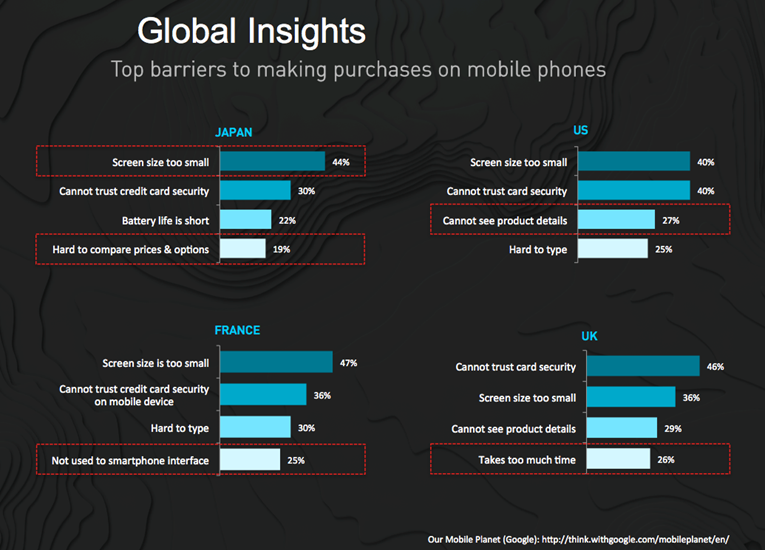
Global firms will need to create a global customer insights strategy with a specific understanding of the local market in order to inform the user experience. A single responsive design is not enough―retailers will have to find a balance between customer experience and scalability, particularly since customer expectations for mobile commerce are going to change dramatically with the larger screen sizes of the iPhone 6 and 6 Plus.
3. Consumer experience will become seamless across channels
Customers don’t care about channel and they will have less and less patience for brands that cannot integrate their experiences and processes. They want to be able to move back and forth between desktop, mobile and in-store experiences without disruption. Global retailers will need to be smarter in their adoption of omni-channel technologies so that customers can research a product online, determine availability via smartphone, work with a sales associate who has the customer’s shopping and purchasing history in a clienteling application, and access customer service through any channel they wish. In addition, clienteling applications will be more commonly linked to proximity-based solutions (e.g., iBeacons and other Internet of Things applications) that will simplify the introduction of the customer to the store associate, eliminating a significant barrier to getting help.
4. eCommerce platforms will become highly customizable through plug-in technologies
Given the incredible diversity of features and requirements needed around the world, vendors cannot keep up with customer demands and are “service orienting” their platforms to enable independent software vendors, agencies and system integrators to create innovative new solutions for specific in-region challenges. Clients will become more reliant on a vendor’s "App Store/Marketplace" model of features, which will bring speed and differentiation to the customer experience platforms they own.
5. Top brands will conquer local markets with local understanding
To think global, you must act local, and that requires a corporate culture that breaks down country barriers and takes local requirements and needs in a balanced way. A quick and dirty adaptation of the brand’s main site won’t generate the type of growth, let alone profit, needed to serve the increasing needs and expectations of global customers. Brands must have a deep understanding of the local market, hire local talent that is invested in the brand’s success, and work with customer engagement providers and vendors who can provide an open solution that can be easily adapted to local market needs.
6. The majority of international growth will come from B2B, not B2C
Although retail will garner the headlines, the lion’s share of international growth revenue will come from B2B commerce. Forrester estimates the B2B commerce market to be more than twice the size of B2C, $252bn vs. $559bn. Maturing B2B models in areas such as financial service and healthcare, as well as the adoption of B2C best practices will drive significant B2B growth. We’ve been hearing this for years, but the trend is becoming more apparent as manufacturers, and pharma companies, for example, work to provide solutions as a service to their suppliers and merchants or network of pharmacies in an effort to increase customer engagement, provider better customer care and drive increased brand loyalty.
The potential for global eCommerce expansion is currently limited only by the ability of brand marketers to understand their customers and drive purposeful experiences. In 2015, successful brand marketers will be the ones that invest in training local talent, and also master the art of turning customer data into a smaller set of actionable insights. The tools and solutions in the market, especially around data, are all there, but like a fine sports car, a skilled and globally passionate operator remains the most important factor.
By Gary Schoch, Global Commerce Lead, Rosetta and Steve Gatto, Partner, Rosetta Europe.
PrivSec Conferences will bring together leading speakers and experts from privacy and security to deliver compelling content via solo presentations, panel discussions, debates, roundtables and workshops.
For more information on upcoming events, visit the website.
comments powered by Disqus