
You have to combine transaction and real-time behaviour in order to analyse and address customers’ buying habits and demands. Your entire customer experience has to be constantly evolving. If you try to optimise only one particular area, you very well may end up causing problems in other areas. For example, requiring from buyers to register before they can shop on your site might initially look like a good idea. However some customers who have no time to fill in the registration from might abandon a shopping cart and move to another ecommerce site.
Providing a great customer experience means focusing on the entire customer lifecycle. Impression which the brand creates doesn’t stop at the moment customer purchases the product. In fact it is affected by multiple factors long time after. Here’s how the buying process breaks down:
1. A customer needs or wants to solve a particular problem
2. In order to find a solution, he researches all of the options
3. After finding a variety of products that can solve his problem, he chooses the one that seems to be the best
4. The customer purchases the product
5. The company fulfils the order. (Just remember, fulfillment can be done in a number of ways – like picking a product up in the store, having it delivered, etc.)
Your branding shouldn’t end when someone hits “Buy”, though. There is number of things that you can do after the transaction to interact with your customers. That’s why the lifecycle continues:
6. Once he has the product, the customer wants to learn how to use it quickly and easily
7. If something goes wrong, the customer might need help with maintenance. Or, he may want to return the product altogether
8. Finally, the customer may want to share his experience with this product
Taking customer through the whole process and addressing each single step is a key to success. If you want your business to succeed, you’ll need to address all eight points in the lifecycle. You’ll have to provide all of the relevant information upfront, then provide help consistently over the rest of the lifecycle. As they move through this cycle, customers want things to be simple, consistent, and relevant. The better the customer experience in each step, the more loyal your customers will be. As long as you can sustain this high level of customer experience, you won’t just acquire customers. You’ll also keep them for the long haul.
While your high growth company has big aspirations – and your agility may place you at the forefront of the customer experience changes – you must be also wise with your resources and often cannot address all customer experience issues at once. Very often business owners start with small customer experience improvements that deliver quick time to value but are a part of long term customer experience strategy.
Measuring the Value of Customer Experience
Of course, you can’t just throw a strategy together and cross your fingers that it works. Just like any other investment, you need to measure its success. According to Oracle there are three major areas that help to measure the value of customer experience – acquisition, retention, and efficiency. In order to see if your customer experience investments are working, you’ll need to focus on the above metrics.
This table illustrates the specific goals associated with each of these metrics. As a result, you’ll be able to measure the progress you’ve made:
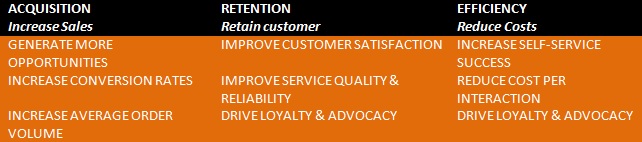
But how do you know if you’re really making the progress that’s described in this table?
Acquisition improvements can be measured by:
• An increase in traffic – whether it comes via your website, your phone, an online chat, your kiosk, or any other way that your sales team engages customers.
• An increase in conversion rate. After all, if having more customers doesn’t lead to more sales, you’re making a mistake somewhere in the lifecycle.
• An increase in Average Order Volume. You should be able to see that more customers are finding and buying a more complete package.
Retention improvements can be measured by:
• An increase in customer satisfaction. If your customers are having a better experience, you’ll see them come back.
• Recommendations made by your customers to other people. Positive word of mouth on internet about experience when doing business with your company
• Increase in Customer Effort Score (CES)*
• Increase in Net Promoter Score (NPS)**
Efficiency improvements can be measured by:
• An increase in self-service success – meaning that more of your customers are able to solve their issues right on your website.
• You can reduce your cost per X – meaning that your agents will handle more cases, close them faster, and close more in the first contact.
• You can reduce your selling, general, and administrative expenses.
The Bottom Line
Anytime you address your customer experience, you need to remember that every customer moves through a specific lifecycle. If you create a strategy that makes every single one of those steps simple, consistent, and relevant, you’ll be able to build a valuable relationship with your customers – while also reducing the money and time you have to spend working at it.
By Cezary Repecki, Managing Director at Ronwe Ltd.
PrivSec Conferences will bring together leading speakers and experts from privacy and security to deliver compelling content via solo presentations, panel discussions, debates, roundtables and workshops.
For more information on upcoming events, visit the website.
comments powered by Disqus