
Digital performance software company, Dynatrace, tracked the homepage response times of over 300 leading retail sites in the UK, US, France, Germany, China, Australia, Spain and the Nordics, testing every 10 minutes for the last 12 months; the resulting report provides unique benchmark data which exposes the fact new website design trends are actually slowing response times, harming customer relationships and negatively impacting revenues.
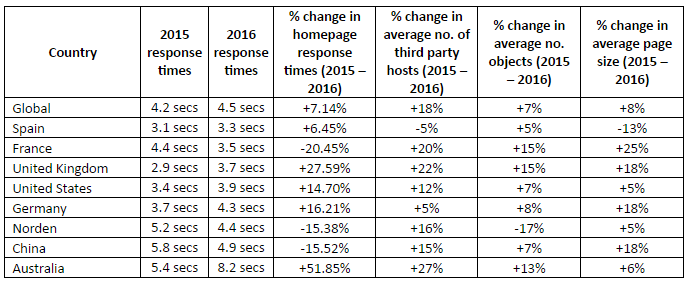
Dynatrace’s analysis shows that, on average, retail websites are getting slower: global average homepage response times increased 7% from 2015 to 2016. While China and the Nordics have made great improvements in the past year, they are still playing catch up against other countries.
France was the stand-out performer, moving from position five in 2015 to take the number two spot behind Spain in 2016, with a 20% increase in speed. The UK, on the other hand, enjoyed poll position in 2015, but has slid down to third place in 2016 and the US was bumped out of the top three. Australia showed signs of trouble, dropping below China into the bottom spot: response times jumped from 5.4 seconds in 2015 to 8.2 seconds in 2016.
When you consider that consumers expect websites to load within 3 seconds or less, and that 46% of consumers will abandon their journey if they are delayed, this is a serious issue for retailers. Putting the problem into context, the report correlates the impact of increased response times on revenues with real-world case studies.
Dave Anderson, VP Marketing EMEA and Asia Pacific for Dynatrace, explains:
“Every digital moment and every touch point is vital to retailer businesses if they are to succeed. While lags in performance are concerning, they also present a big opportunity to measure response times more closely and link it back to revenue. Take a leaf out of Nordstrom’s book – it has measured that a mere 0.5 second slow-down in site load time equates to an 11% reduction in site conversion. This is precisely where retailers need to focus internal conversations: looking at site performance and how it impacts revenue. Otherwise, they’re choosing to leave money on the table.”
When looking at the causes, it is evident that retailer efforts to ‘woo’ customers with more third party hosts – such as Facebook and Twitter – as well as more images and objects, and bigger pages, are actually proving to be counter-productive.
There is therefore a clear correlation between the page size, number of third party hosts, and number of objects and the speed of homepage response; when it comes to websites, less is more and bigger isn’t better. All of the top performers had small page sizes, smaller object counts and fewer third party hosts.
It is also evident that retailers are very keen to look after their home markets. All of the top five performing websites in the Nordics, US, Spain and China were native to that region, and four out of five were in the UK and France. However, in Australia, the US actually out-performed local retailers by taking 3 out of five of the top slots.
Anderson continues:
“If you are a global retailer, looking to target a new geography, you need to know what you are up against in the local market. This is why benchmarking is so critical, as it can help you to better understand user expectations. For example, China is a huge market that most retailers are chomping at the bit to dominate – yet looking at the top performing websites in this region the websites are very stripped back, hardly any hosts, so to compete international retailers will need to follow suit: there is no one size fits all. Yet local retailers have no room to be complacent. As we can see from Australia, and the dominance of Apple, digitally savvy competitors are a real and present threat.”
PrivSec Conferences will bring together leading speakers and experts from privacy and security to deliver compelling content via solo presentations, panel discussions, debates, roundtables and workshops.
For more information on upcoming events, visit the website.
comments powered by Disqus