
In any given year, an average of 8% of the UK’s adult population moves home, according to the Office of National Statistics. For brands, a home move means more than a customer registering a change of address. It’s a time when as many as two-thirds (65%) of consumers switch retailers and reconsider their existing relationships with suppliers.
When paired with recent Royal Mail findings that reveal UK businesses lose one-fifth (20.7%) of their customer bases each year, it is clear that keeping fast-moving customers engaged is a major challenge facing marketers today.
Addressing the challenge
In an environment in which personalised, digital marketing is increasingly the norm, marketers can no longer rely on traditional and static sources of data. This is particularly true when marketers are seeking to effectively engage home movers.
Now dynamic data sources can tell marketers when and why customers are most in need of their products and services. This enables brands to launch nimble, targeted mover-marketing strategies that reach consumers in the moments when they are most likely to buy.
Brands using dynamic data to fuel their life-event marketing strategies are proven to experience increases in their response and conversion rates. Marketers can also improve customer loyalty and reduce the risk of customer churn. Here we outline four basic principles to identify and engage with customers on the move.
1. Recognise the opportunity of the home-move period
The home-move period presents opportunities for brands to re-engage existing customers, as well as target new prospects.
According to our research, recruiting new customers is the biggest challenge for 45% of marketers. The remaining 55% struggle with re-activation, upselling, retention and cross-selling to existing customers.
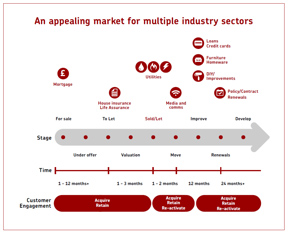
The home move often inspires consumers to consider switching brands, such as utilities, telecoms, media, insurance and financial services providers. It is also a time when consumers buy products and services such as homewares, furniture and electrical goods for their new homes. Some may go looking for specialist services from interior designers, landscape gardeners and home improvement companies. The need for professional services also increases during this time, which can be good news for lawyers, financial advisers and accountants.
Conservative estimates based on research from YouGov reveal that, within a year of moving, the average home mover spends around £5,000 on move-related goods and services, and £8,000 on home improvements. But brands need to have the right processes in place to tap into the home-mover market.
2. Establish the systems to launch accurate and timely home-mover campaigns
Before marketers can analyse and act on dynamic customer data, they need to look at their systems. Marketers need the agile processes and technologies that allow planners to identify their customers’ changing life circumstances and engage them in real time.
In turn, marketers need to have the capabilities, tools and resources in place to handle “closed-loop” life-event marketing. This means the ability to continually assess the effectiveness of their life-event campaigns and being ready to rapidly adapt and adjust strategies as necessary.
3. Maintain data quality
Accurate customer contact data is a key element of successful data-driven marketing. Without clean and up-to-date information, marketers cannot accurately target existing or potential customers.
Collecting and cleansing customer data is not a one-off job. Organisations must invest in automated processes to ensure data is continuously checked and updated. Ensuring properly maintained data is critical to realising the potential of targeting customers on the move.
4. Look for life-event triggers
Once the mechanisms are in place to track customer moves and respond quickly, marketers must personalise their messages. This means understanding at what stage in the customer’s move their products and services will be most relevant.
The home-move process often takes months. Over this period people give off a number of indicators that they’re entering the home-mover market, such as registering with estate agents and online home-search portals, researching mortgage or loan providers, or taking out a Redirection. This all depends on the customer granting a trusted provider the necessary permissions to access this data.
To gain visibility into these triggers, marketers need access to up-to-date, accurate and permissioned customer data from a trusted third-party provider. Once marketers understand where a home mover is in the process, they can target them with the right offer at the right time, subject to proper permissions.
Mover marketing in action
This data-led approach to home-mover marketing is already working for many brands. One leading retailer of upholstered furniture found that one-fifth (21%) of its sales were results of people moving home. The brand now puts home movers at the core of its marketing strategy.
Well-managed customer and prospect data can deliver mover-marketing campaigns that overcome the most common challenges brands face: customer retention and acquisition. This data can also support companies with re-activation, cross-selling and improving brand profiles.
By Jim Conning, managing director at Royal Mail Data Services
Want to keep up with the latest ideas in Digital Marketing? Free conference and exhibition Integrated Live is the place to be.
PrivSec Conferences will bring together leading speakers and experts from privacy and security to deliver compelling content via solo presentations, panel discussions, debates, roundtables and workshops.
For more information on upcoming events, visit the website.
comments powered by Disqus