
Social media has always been difficult with financial services. Whereas many industries have embraced this relatively new way of interacting with customers and getting information there’s always been trepidation from people with the money. The many rules and regulations imposed by governing bodies such as the FCA (Financial Conduct Authority) have meant that brands and those in the industry have been wary of getting involved. Within the past few months though, there have been more distinct guidelines on how companies in the industry should use social. Will this open the door for greater involvement? Twitter, the second most used social media platform has been adopted by many brands in financial services, but why is it so well suited?
You can get information quickly
There are upsides and downsides to the fast paced nature of social media. Inevitably with the rapid conveyance of information there is room for error. In the rush to get information to the masses as quickly as possible there will be mistakes, but in financial services particularly, this is counteracted by the importance of speed. In an industry where being ahead of the curve is of vital importance, Twitter gives us all the opportunity to both give and receive information as it happens. Indeed many events now have live twitter update screens where attendees can tweet their ideas and opinions. As there is often a lot of damage limitation in the industry too, it’s also a great way of immediately interacting with customers and followers. Twitter in particular is perfect as it limits word count meaning information is concise.
It’s a who’s who
Financial brands are finally beginning to catch up with everyone else on social media. All of the major journalists and industry voices are already engaging on social media and it’s the perfect place to get information. Zak Mir of industry publication Spreadbet Magazine explains “If you follow the right 20 - 30 people in the trading and financial markets area then you should be fully informed in terms of what to think, what to trade and when to trade it. Yes, Twitter is that good”. There are also great additions to the site like the ‘blue tick’ feature which can help confirm the identity of people. You can’t apply for the feature either; Twitter dishes out the blue tick upon their own merit system. Here are some industry influencers worth following within the world of finance:
- Financial Times (Business and economic news)
- Nouriel Roubini (Professor of Economics)
- Spread Co (Daily Market Updates and Financial News)
- Jim Cramer (Host of ‘Mad Money’)
- Dina Medland (Journalist for Independent/Jorbes)
It gives an insight in to public opinion
Many brands complete surveys and commission studies to gage customer and public opinion. In the first quarter of 2015, there were 302 million monthly active users. That is a large community of people, which is why many brands use it to help get an insight into sentiment on their own brand and world events. However, we should approach this method of analysing public sentiment through Twitter with some caution. During the Scottish referendum, the vast majority of online sentiment on Twitter pointed towards a victory for the ‘Yes’ camp. In the end there was a marginal victory for the ‘No’ camp. This perception was most likely due to the skewed results arising from the demographic of the platform. In general Twitter users are younger than the other major platforms, coming in at an average age of 37, more of this younger demographic voted ‘Yes’ in the vote, which explains the misinformation.
There’s evidence it affects share prices
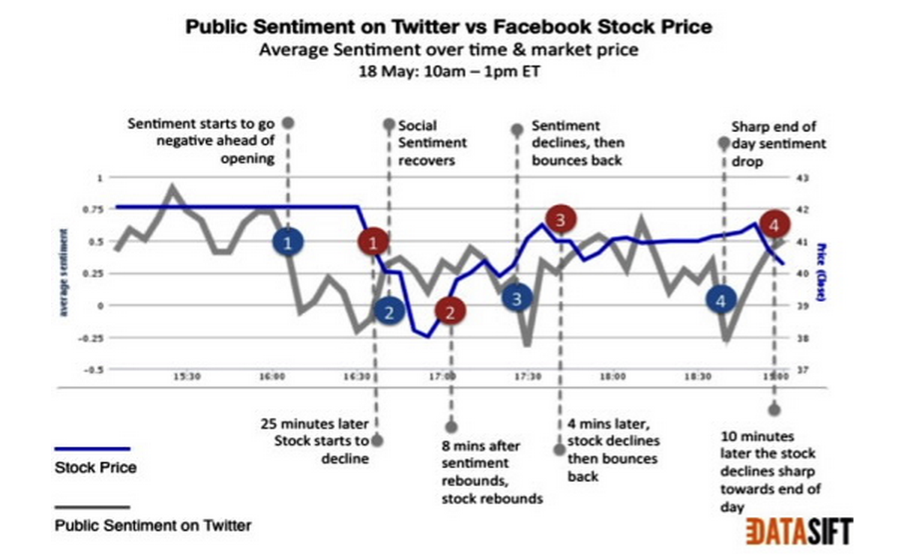
As well as being a good barometer of public opinion there is also some evidence that the social media platform has a direct effect upon share prices. There’s been a lot of research in to the effect of Twitter sentiment on share prices and this has indeed lead to the creation of tools such as Wall Street Birds, which provides in depth analysis of the perception of brands and events online, making it a useful tool for stock market traders. A study by Datasift in 2012 showed a big correlation between the sentiment of Twitter users about the Facebook brand and the change in share prices. The graph below shows this, with sharp declines in price in line with more negative perceptions from users online. Although this isn’t a definite science it’s another indicator from the platform worth looking at when working in finance.
Social media is useful in many industries, as a way of getting information quickly and staying ahead of the competition. It can be used to garner public opinion, which in industries where this can have immediate effect upon business can be very important. However, it should be pointed out that as with any form of media there is room for misinterpretation. Social media user’s demographics are young, and unlike more traditional media, it has little opportunity for quality control. Twitter is fantastic for financial services because so many experts use it, but more importantly that they give you the opportunity to engage directly with them. Anyone in the industry should use it, but only as one tool in a diverse tool belt.
By Sean McMahon, Content & Online PR Executive at Search Labatory.
PrivSec Conferences will bring together leading speakers and experts from privacy and security to deliver compelling content via solo presentations, panel discussions, debates, roundtables and workshops.
For more information on upcoming events, visit the website.
comments powered by Disqus