
One of the most intriguing platforms to emerge out of the social media boom of recent years is Tumblr. The site has quickly become one of the most popular destinations on the net, yet many brands stay away out of ignorance.
Indeed, while each of the top 100 global brands have Facebook and Twitter accounts, only 30% of them have embraced Tumblr. This is rather surprising given the site’s impressive user statistics: in a survey from GlobalWebIndex in December 2013, 34 million people said they contribute to or use Tumblr on a monthly basis. As of July 2014, the site had generated 83.1 billion posts from 196.8 million blogs.
But isn’t Tumblr an ‘American thing’?
Tumblr is most popular in the US, with 32.6% of visits coming from the States. Only 4.4% of visits come from the UK which may explain why brands are staying away. Unlike Facebook and Twitter, its global reach is somewhat limited, so if you’re aiming at a primarily non-US demographic, you might not think it particularly worthwhile to invest resources in a platform that only a fraction of your target audience is going to see.
However, just because you can’t speak directly to your target audience doesn’t mean you can’t create a healthy relationship with them indirectly by building your brand reputation. Tumblr is the self-proclaimed Home of the Creators. It’s one of the most original and creative social networks on the internet, with users publishing memes, GIFs, images and videos, many of which accrue a huge number of ‘notes’ (likes or reblogs) and subsequently go viral.
Tumblr strategy – the art of ‘creative recycling’
There’s no magic formula for hitting the jackpot on Tumblr; rules and logic don’t seem to apply. A GIF from a TV show can gain over 150,000 notes, while a picture of a gold watch can gain over 260,000 notes. Even a picture of some flowers can attract over 85,000 notes. These are all visual posts, but on a site like Tumblr, where so much of the fundamental design of the site is image-led, the fact that visuals do better than text goes without saying. There’s very little else to connect these posts, so what guiding principle can be used to instruct a Tumblr strategy?
The key to all social networks is to deliver something ‘new’, and that’s doubly true of Tumblr. A Kim Kardashian GIF may not be unique in itself, but it can be applied cleverly by other users – added to a post as a punchline, to emphasise an emotion, or to make a point, this ‘creative recycling’ of a GIF contributes to boosting its notes. If the success of the gold watch and flowers pictures proves anything, it’s that something so small as a good photo of an attractive item can go viral.
It’s about playing the long-game
Success on Tumblr is not immediate. You have to work at it; indeed, as paid advertising is limited in comparison with the options available on Facebook and Twitter, you might need to work harder on Tumblr than you would elsewhere. You need to consider a long-term strategy that puts imagery and creativity at the forefront, and makes use of the area that Tumblr excels at: tagging.
All blogs make use of tags. They help the blog owner order their posts and make searching easier for the reader. On Tumblr, however, they’re not just an effective means to organise posts, but a vital way to amplify them. Tumblr tags are no different to hashtags on Twitter, allowing users to group posts together under a single topic. But whereas hashtags tend to be reactive and fleeting, Tumblr tags offer a service something more akin to a search engine.
Search for a word on Tumblr, and you’ll be inundated with a seemingly endless list of results, no different than if you’d put the same search into Google. Your search can be very broad or very specific, either way it’s likely to bring up a vast number and variety of posts: text posts, images, videos, GIFs. The depth of content is limitless, as is the opportunity for brands.
If it’s good enough for Disney…
Tumblr is a tremendously powerful content discovery network where the most creative and unique content succeeds. Even the ‘big players’ recognise its value as a brand development tool. For the release of its 2014 film Maleficent, Disney set up a Tumblr blog called Evil is the New Black, brimming with visual information.

In terms of content, Disney provided clips from the film, but was not reliant on it. Instead, it leveraged the iconic status of its star, Angelina Jolie, to appeal to its core demographic by adding fashion content. This allowed Maleficent to be more than just a film; it was a statement. Watching it meant you were embracing all the cool aspects the blog covered.
Coca-Cola is another global organisation to embrace Tumblr, positioning its blog as ‘where happiness lives online’.
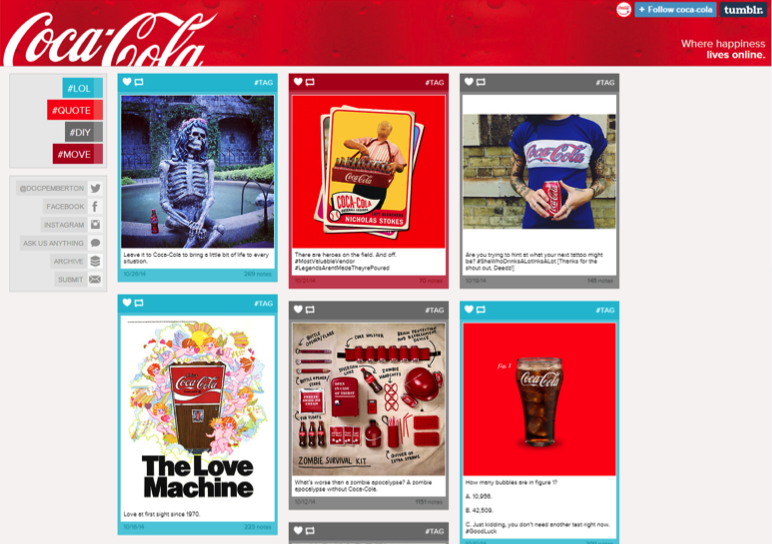
Its posts are split into distinct categories, while the blog emphasises creative and reactive content, and although the vast majority of posts include a Coke bottle, the blog still feels lightly branded. Rather than repeatedly forcing the product, Coke instead makes it secondary to the core brand value.
Making Tumblr work for your brand
There are a few key points for businesses to bear in mind, which will ultimately enable you to use the platform to its full potential as a marketing tool for your brand. Tumblr content isn’t just about putting your posts out there and expecting them to be well-received. It’s about being an active part in the wider community. Your posts should take up around 80-90% of your output, but you should also re-blog. It makes you look generous, respectful and, most importantly, a part of the group.
There’s so much content on Tumblr that it’s easy to repeat things. Find your niche and work out a creative way into it. Give people something new to share, and keep an eye out for the creativity of others to position yourself not only as someone creative, but as a curator of creativity. Furthermore, make sure that visuals are a core element of everything you post to the site. Written content is vital to any successful digital strategy, but on Tumblr, it’s pictorial content that makes the biggest impression.
Finally, be patient. Tumblr blogs can be built in a day, but successful ones can’t. Take your time to devise a smart, long-term strategy and bit by bit, bloggers will find you, engage with you, and ultimately buy your product.
By Paul Bullock, Content Marketing Expert at Fast Web Media
PrivSec Conferences will bring together leading speakers and experts from privacy and security to deliver compelling content via solo presentations, panel discussions, debates, roundtables and workshops.
For more information on upcoming events, visit the website.
comments powered by Disqus