I’m not sure when social media became completely unbearable, but I know why it did; at some point in the past few years, a blue-sky-thinking value-add social media fanbassador went around telling companies that their consumers ‘want to have a conversation’ with them. Social media users have been plagued ever since.
Instead of simply informing users about special offers and company news and responding to enquiries, suddenly many businesses are determined to be best mates with their followers – and worse, other businesses. Emoticons have never been so abused by those who should know better, and consumers have never been so inundated with interactions from would-be-matey companies.
Remember that Twitter exchange between Tesco Mobile, Jaffa Cakes, Yorkshire Tea and Cadbury’s last Christmas? Buzzfeed optimistically assured us that ‘This is the best Twitter conversation you will read today’. It went something like this (but 10 times longer and over the course of a few hours):
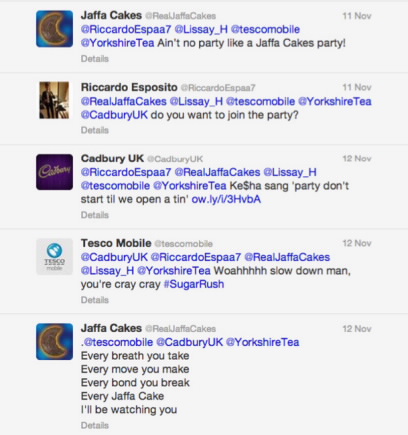
Shouts of delight went up from self-proclaimed social media gurus across the land, who immediately spanked off umpteen blog posts advising their followers, “THIS is how it’s done. 5 million retweets, 50 gazillion impressions! More proof that you should engage your consumer – invade their newsfeeds, be their friend, not a cold faceless corporate!”
So how should businesses talk to consumers on social media?
Consumers are wising up and starting to tire of businesses trying to be their buddies online. All businesses should be prepared to speak to their customers as they would in a shop on the high street – professionally, and with respect.
I’m going to go out on a limb here by pointing out that there are actually several benefits of portraying yourself online as a professional business, rather than as a child who’s hijacked the company Twitter account:
1. You are a professional company! You have a service or a product to sell, and your end goal is to sell it. Dressing it up in ‘LOL’s and ‘:-)’s is an insult to your intelligent, marketing-hardened customers. They want Jaffa Cakes and extra minutes, not a stream of emoticons in place of business value. If you can provide them with useful information whilst cutting out the emoticons, ‘yay’s and ‘nom nom noms’, then you’re saving your consumers considerable time and not a little distress.
2. Pretty soon consumers are going to realise en masse that Jaffa Cakes aren’t really their friends, and that they’ve mindlessly succumbed to a calculated brand-evangelising exercise. They’re going to be incredibly annoyed about this (but will probably be too busy Instragramming said Jaffa Cakes to revolt).
The worst offenders of social media infantilisation by far are B2Cs, but it isn’t their fault. Their social media fanbassadors have assured them that it’s imperative to engage with the consumer at any cost, so they’ve invented corporate personalities and dumbed down their language in typical ‘dad trying to be cool’ fashion, which is irritating, cringey and condescending.
Does any consumer really want a big brand to be their best mate? Isn’t it a bit creepy? And where is all this leading? Will it, as Simon Armitage enthusiastically predicts, lead to the downfall of society? Or (more likely) will it lead to a gradual mass exodus of consumers from the razed public hunting grounds of Twitter and Facebook to newer, more sheltered social climes such as Snapchat and Whatsapp?
By Mary Stringer, Marketing Consultant at Resonates and blogger for The Metro.
PrivSec Conferences will bring together leading speakers and experts from privacy and security to deliver compelling content via solo presentations, panel discussions, debates, roundtables and workshops.
For more information on upcoming events, visit the website.
comments powered by Disqus