
In this key time of year the race for Christmas ad supremacy is obviously of utmost importance. Nobody wants to be responsible for this year’s Christmas turkey. But while it’s great to hear what creative people say about the ads, surely it’s the consumers we really care about.
That’s why we have asked Dentsu Aegis Network agencies Carat and iProspect to get their social listening experts to find out what the populace thought were the Christmas Crackers, the unwanted uncles and the undercooked sprouts.
Sainsbury’s
Move over John Lewis, there’s a new Rudolf in town. Christmas this year belongs to Sainsbury’s. The ad received 24,000+ mentions in the first week alone (however, it is worth noting that a lot of these mentions are about the chocolate and not just the ad). The Hashtag #christmasisforsharing was used in 34% of tweets, far ahead of the second most popular Hashtag #sainsburys in just 3% of tweets. The partnership with the Royal British Legion was generally well received, with the words ‘poppy legion’ and ‘proud’ featuring heavily. Interestingly the ad benefitted from being the last to air because people spent a lot of time comparing it to the rest.
Buzz: 24,401 mentions
Sentiment: 29% Positive / 55% Neutral / 16% Negative
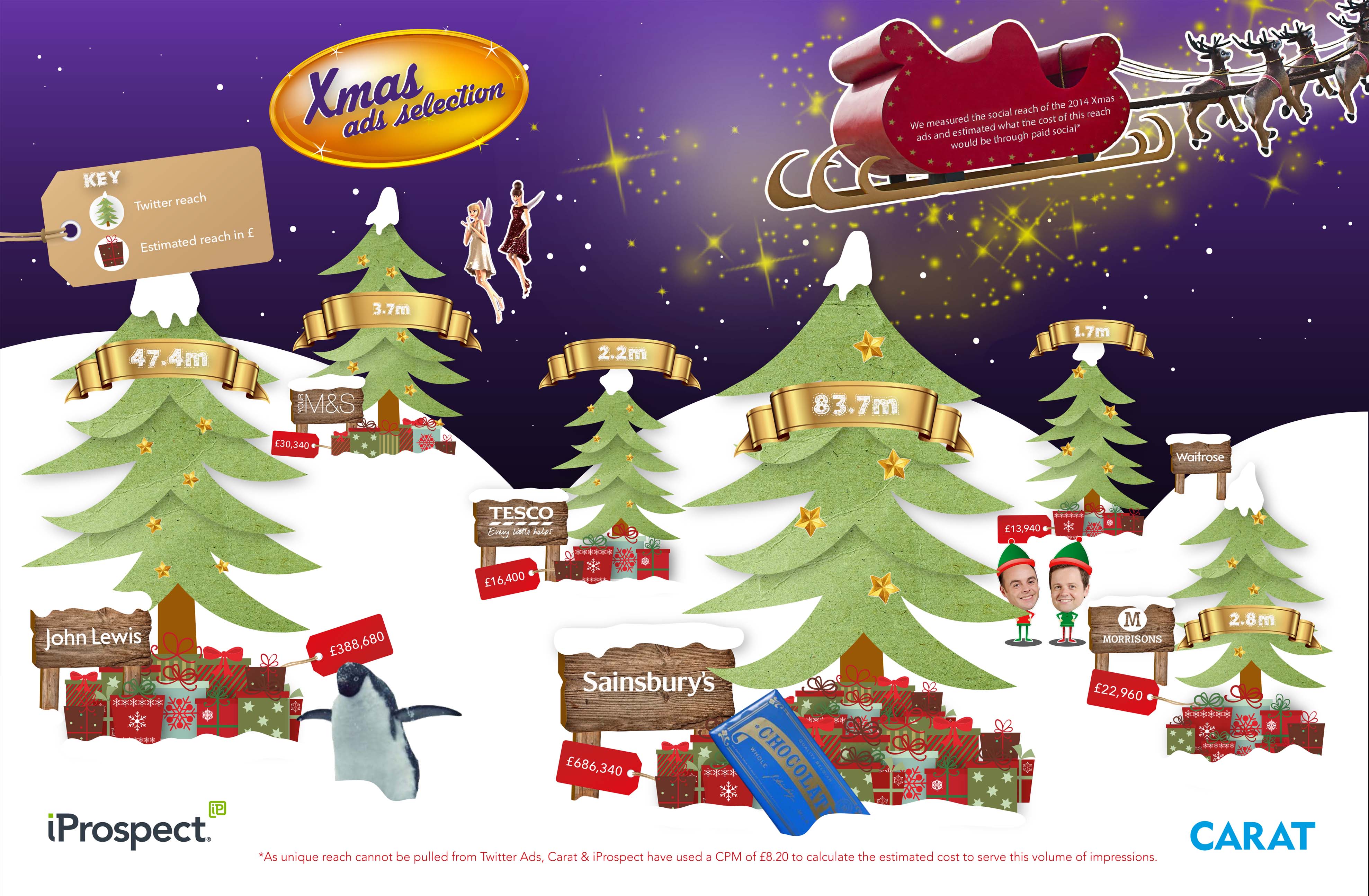
Reach: 83.7m
Hashtag use: 8,042
John Lewis
The big one. The game changer. The icing on the cake. The star on the Tree. Well, not this year. John Lewis and Monty the Penguin were second to the football playing soldiers of the Sainsbury’s ad. Its buzz and mentions were also way down on last year’s ad, where John Lewis was basically the best thing that happened for many over the entire Christmas period. Launching during Gogglebox, a very highly tweeted show, was good buying strategy and drove much of the ads’ engagement and a large percentage of the 14,700 mentions. #Montythepenguin was also the most popular Hashtag with 6,676 mentions. While not in any way a failure, John Lewis may well be suffering a little Boxing Day hangover.
Buzz: 14,702 mentions
Sentiment: 36% Positive / 51% Neutral / 10% Negative
Reach: 47.4m
Hashtag use: 6,675
Tesco
While Tesco’s awe inspiring celebration of Christmas lights may not have lit up the social-sphere like the Tree in Times Square, it was still a very successful campaign. With 833 mentions and 53% of posts carrying a positive sentiment it fared well against most of its competitors, with only John Lewis, Sainsbury’s and Waitrose garnering more buzz. Much of this positive sentiment was driven by the added extra of being able to view the whole lightshow online (which the Mirror called “the most spectacular lightshow since the London Olympics”) after the ad debuted on TV. A very intelligent and effective move, which picked up 650,000+ views on YouTube.
Buzz: 833 mentions
Sentiment: 53% Positive / 37% Neutral / 10% Negative
Reach: 2.2m
Hashtag use: 355
M&S
M&S’s effort was a good solid example of using intelligent investment in campaign related social to really push your message. Despite only attracting 534 mentions, the fact that it promoted its Christmas handle @thetwofairies and used this to push its CSR messages saw its reach fly up to 3.7 million - a very big number. Further proof of the strategy being effective can be seen in the fact that 23% of its buzz happened on blogs and in news stories (this is low single figures for most ads). There was also a lot of positive sentiment in forums – a key area for content discovery.
Buzz: 534 mentions
Sentiment: 42% Positive / 51% Neutral / 7% Negative
Reach: 3.7m
Hashtag use: 188
Morrison’s
This year Ant & Dec are the anti-Jools Holland. The ad garnered a lot of positive sentiment (31%) because people really love the canny pair of lovable Geordies, unlike the Aldi ad that suffered because of the ivory tickler’s short appearance. Fans spent a lot of time simply discussing how much they love the pair. Despite only getting 284 mentions (relatively low) the ad had a very high comparative reach. This was largely due to high authority Twitter accounts discussing the ad eg. Marketing Week and Daily Express.
Buzz: 284 mentions
Sentiment: 31% Positive / 60% Neutral / 9% Negative
Reach: 2.8m
Hashtag use: 53
Waitrose
Waitrose was another ad, like Argos, that profited from the choice of song. People went mad for the cover of the Dolly Parton song “Try” sung by Waitrose customers (43% positive sentiment and more than 800 mentions). The fact that the profits went to charity was the Brandy on the Pudding. Waitrose also benefitted from people comparing it to the ad by John Lewis (obviously sharing a parent company) as that advert was released only a day earlier.
However, they missed a trick by not integrating their Hashtag into the ad and only choosing to spend budget on promoting 8 days after launch, once interest in the execution had died down.
Buzz: 861 mentions
Sentiment: 43% Positive / 43% Neutral / 14% Negative
Reach: 1.7m
Hashtag use: 1 (There are 145 mentions overall since the video was launched but Waitrose didn't start using the hashtag until 8 days after)
Lidl
While the Lidl ad’s premise of a pleasant surprise may have worked for the real people/actors of Hertfordshire, it didn’t go down quite so well with the general public. Much of this was down to the timing, as Lidl was embroiled in a race row when the ad broke, which saw people using the ad and its #lidlsuprises Hashtag to sarcastically discuss the story. However, it’s not all bad; most of the positive sentiment around the ad came from people agreeing that Lidl products were surprisingly good.
Buzz: 311 mentions
Sentiment: 1% Positive / 84% Neutral / 15% Negative
Reach: 1.1m
Hashtag use: 266
Boots
The Boots ad is actually a strange one and highlights why you need to be really careful how you analyse your social data and take context into account. The overall sentiment for Boots is 46% negative, 28% neutral and 26% positive. At first glance this looks really bad for what is, a good ad. But after looking at the conversations more closely you can see that a large amount of the negative mentions were down to people having a strong emotional response to the advert eg. “The Boots advert made me cry”.
Obviously this is the affect the ad is trying to achieve and these conversations should be construed as positive rather than negative. Lots of people actually connected with the nurse and suggested they’d do the same ‘surprise Christmas’ for their family members. #SpecialBecause was mentioned a total of 317 times and reached peak popularity on the 13th November when Boots tweeted a YouTube link to the video and asked fans who is special to them – a very canny strategy.
Buzz: 655 mentions
Sentiment: 26% Positive / 28% Neutral / 46% Negative
Reach: 707,536
Hashtag use: 317
Argos
The bold move of completely ignoring the classic trope of traditional Christmas scenes and the modern trend of sentimentality and replacing it with good solid Christmas Hip Hop paid off for Argos with lots of positive attention around the song. #Christmasinhollis was the 4th most used Hashtag while #rundmc gave John Lewis’s #Montythepenguin a run for its money as the second most used. Its airing during the X-Factor, one of the most Tweeted about programmes on TV, also helped. However, by not having an advert specific Hashtag they missed the opportunity to create a lot more buzz. This is a lesson retailers need to learn.
Buzz: 213 mentions
Sentiment: 39% Positive / 26% Neutral / 35% Negative
Reach: 625,405
Hashtag use: 16
Aldi
While the Aldi ad didn’t quite get the engagement the company would have hoped for, they could have avoided much of their negative sentiment (31%) by removing the Jools Holland Cameo at the end. This stirred up quite a lot of negativity on blogs and forums.
A comparison with M&S’s clever social strategy can be seen here. The Aldi ad grabbed just 100 fewer mentions than the M&S effort, but only attained a reach of 504,037 compared with M&S’s 3.7 million. Lessons again that just shoving a Hashtag into the creative isn’t enough these days.
Buzz: 403 mentions
Sentiment: 18% Positive / 51% Neutral / 31% Negative
Reach: 504,037
Hashtag use: 27
House of Fraser
The negative sentiment for this ad was 62%; this is miles higher than any other Christmas ad this year and it is the result of a brave/risky move backfiring. While hiring beautiful models to front the campaign may fit with the fashion led brand, it did not sit right with the average consumer. Regular people just couldn’t connect with the angular stunners on screen. The meagre 1% that enjoyed the advert enjoyed it because they thought it seemed authentic and modern. Not a great pay-off. House of Fraser also made the mistake of not having a Hashtag associated with the ad – this significantly lowered its reach.
Buzz: 152 mentions
Sentiment: 1% Positive / 37% Neutral / 62% Negative
Reach: 422,488
Hashtag use: 66
Lessons
There are some great ads in this year’s crop and much to feel festive about, but there are also lessons to be learned.
· Spend some budget on a full paid social strategy to drive mentions and buzz once the ad has launched
· Give your work a Hashtag and ensure it is clearly seen in the ad
· Look for context when analysing your social results
· Pick a good song…..it can do wonders
Methodology
The Social Media Insight team at Carat and the Earned Media team at iProspect measured social buzz in the UK over the week immediately following each advert’s release date. Social buzz includes blogs, forums, tweets, and news articles - sentiment is measured across all of these. Reach and hashtags are measured across Twitter only.
By Andrew Fairclough, Head of Social Media Insight at Carat and Ed Hartigan Head of Earned Media, iProspect UK.
PrivSec Conferences will bring together leading speakers and experts from privacy and security to deliver compelling content via solo presentations, panel discussions, debates, roundtables and workshops.
For more information on upcoming events, visit the website.
comments powered by Disqus