
If you think attrition is unavoidable and re-engaging unnecessary, let’s consider two reasons why you should have a re-engagement strategy in place to try and get your disinterested subscribers interested again:
Reason 1: There’s money in that list. There will always be a certain percentage of your list that’s inactive. Minimising that inactive segment, while not an absolute goal in itself, means re-engaging them. And you have the advantage. At some point they wanted to hear from you, that’s why they subscribed in the first place. So they are not a cold faceless @-sign, but a real person that opted-in and once asked to get your emails in their inbox. It’s much easier to engage someone who already is aware of your brand.
Reason 2: It could be you’ve messed up. It could be you brought the disengaged subscribers on yourself, by not delivering on your promise, by emailing too often, or by sending sucky content. If bad quality is the case, learn from your mistakes and up your game to create content people want to get.
Or it could be you used gimmicks and mirrors to get subscribers to sign up, like the often seen generic prize draw. But in doing so attracted the wrong group of subscribers that were never destined to be long-term loyal customers in the first place. With the result that you were welcomed into their “stuff I never read anyway” mailbox, consumers hold separate mailboxes for that.
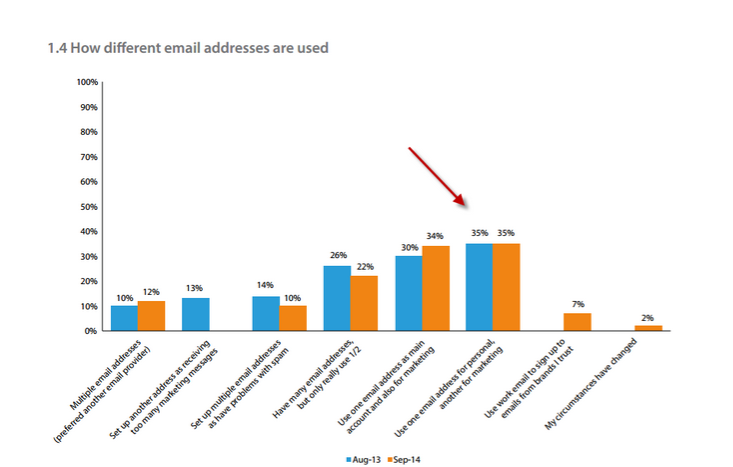
The National email tracking study showed that 35% of consumers, maintain separate addresses for marketing purposes, but also 10% has a seperate inbox for spam reasons (where they park those gimmick-laden persuaded subscription mails from brands they didn’t love.)
Please just kiss those subscribers goodbye. Reevaluate how you determine list growth success - you can’t re-engage someone who was never engaged in the first place.
There’s a third reason: Re-engagement is worth the effort. Didn’t I just say that already? Not completely. You can imagine the upside, but the actual investment to get an automated re-engagement track done is actually quite low. Especially if you have the right tools and possibly a superior agency.
Why would we call such emails re-engagement emails? Because we want the consumer to once again engage with our brand— to open that email and the subsequent ones too. It’s not enough to get the disinterested subscriber to open one email, what we really want is consumers liking our brand all over again.
So what makes a re-engagement campaign re-engaging? You might start with the usual “give us another chance” or “we miss you” messaging, but your email must go beyond that. In fact, your whole campaign should go beyond that.
There are the usual techniques for your re-engagement email, such as:
- Give them an incentive for buying again
- Let them update their preferences, either with a dedicated landingpage, or link to your preference center (You do have a preference center, right?)
- Give them several options, either in incentives or options
- Give them lots of reasons for re-engaging.

But no matter the route you decide to go, we have six principles for making that re-engagement email even more engaging and effective.
Principle 1: Stay on brand
Regardless of the method or message you choose, be sure your re-engagement emails stay on brand, like this example from Urban Outfitters. It’s not only designed to look like, but is written like text messages too—text messages from a needy boyfriend or girlfriend, that is, which is totally in line with the brand.
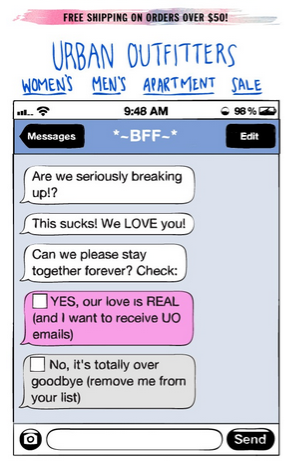
You want to stay on brand for several reasons, you want to remind them of your brand promise because at some point they said “yes” to hearing from you—when they subscribed—and maybe they have simply forgotten what your brand offers. Doesn’t mean that you can’t mix it up and add a bit more edge than usual.
Principle 2: Make it interesting
That said, you might not want to stay on brand if that means you’ll be sending out a dry, boring email! (But then that might be why people are losing interest in your emails in the first place?) The Urban Outfitters email is on brand, but it’s also kind of entertaining, sure to cause a chuckle or too. And if someone is going to opt out from hearing from you, wouldn’t you rather they do it with some warm fuzzies for your brand?
Principle 3: Test your subject lines
What else do you not know about your subject lines? Find out. Try using a variety of approaches, from emotional or even pathetic (“Did we do something wrong?”) to hard line and direct (“Respond by May 30 to keep getting these emails”). Just because one way or another appeals to you as a marketer doesn’t matter. You need to figure out the subject lines that work to get your inactives to open. Remember,
these subscribers have not reacted to earlier mails, so doing something different than normally works might just be all the doctor ordered.
Principle 4: Increase frequency
Yes it might seem counterintuitive, but if your email frequency is too low, it might just be that they haven’t heard from you in a while or just skipped over your mail. Use a good excuse to send more in a short period, in the form of a series. Over the course of a couple of weeks (or whatever your testing shows works), send a series of re-engagement emails as opposed to just one email each period.
Principle 5: Target your efforts
Try to segment beyond simply “inactive,” into smaller, more targeted groups so you can create content and offers particularly relevant to that group (or those groups). You definitely want to segment out your actives (and possibly further segment into two groups of more than and less than X months of inactivity). But then dig deeper and refine yet again. Send some über targeted emails and see if that gets them interested once again.
Principle 6: Stay up to date on preferences
This email from Office is no-nonsense, essentially ask if the consumer is male or female, so the brand can make sure they are sending the right content.
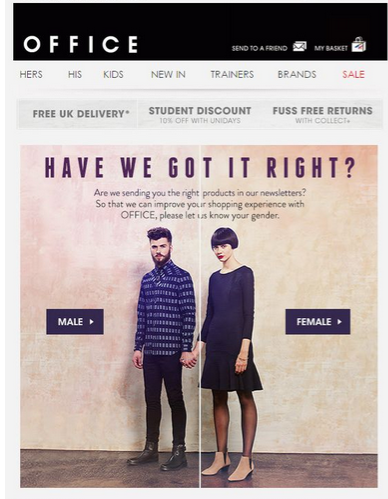
But what a brilliant way to re-engage. It takes little time to respond, and honestly, wouldn’t you want to clarify your gender if it were called into question? Then the after effect of this might be consumers who look forward to the next email, wondering how it will differ after they’ve clarified whether they’re male or female. Plus you get the added benefit of learning more about them so you can do a better job of segmenting and targeting later.
Granted, doing this also gives them the option to opt out. You might think that’s a strange idea for a re-engagement email, but if they really don’t want to hear from you, they are just dead weight on your email list and you’re better off without them.
Bonus tip: Be patient
Don’t drop people immediately after sending your re-engagement series. A Return Path study found it can be weeks or even months before someone takes action in response to a re-engagement campaign. Keep these in escrow on your main list folding them back into the program. But don’t drop them altogether until after a predetermined amount of time has past.
By Jordie van Rijn, emailmonday.
PrivSec Conferences will bring together leading speakers and experts from privacy and security to deliver compelling content via solo presentations, panel discussions, debates, roundtables and workshops.
For more information on upcoming events, visit the website.
comments powered by Disqus