With the Rugby World Cup 2015 nearing completion, this year’s tournament has seen an explosion on Social Media, particularly Twitter.
Never before have fans been able to stay so in touch with the competition and Rugby’s global family.
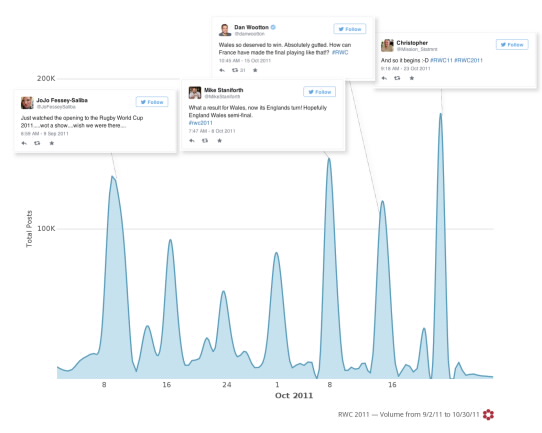
Four years ago, Twitter was just finding its stride and conversation around #RWC11 totalled a volume of 1.9 million posts during the 2 month campaign. In previous years travelling to the other side of the world was as close as you could get to the action, but today is a completely different experience. To get a feeling of how the players have reacted, the starting line-up, running commentary or post-match analysis, all we have to do is turn to Social.
Leveraging our platform we are able to analyse the volume trends in conversation, not only for this year's competition, but for past tournaments. The graph below shows the volume of Twitter posts throughout the 2011 Rugby World Cup and during the week before and after the tournament. The peaks coincide with the major games, the first being the opening ceremony and the last three corresponding to the Quarters, Semis and lastly the Final between the All Blacks and France.
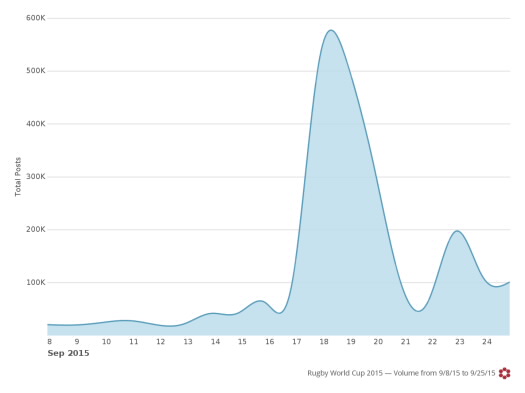
Now compare that to this year's tournament where we saw 1.1million tweets in the week preceding Kick Off (9th - 17th September) and a staggering 3.4 million in the first week alone (18th - 24th September).
 This tournament is set to be the most talked about, most viewed, most publicised in history. Almost 10 million viewers tuned into the opening ceremony, making it the most-viewed sports event in the UK to date. Twitter has even added their own unique Emoji’s for each team and hashtag...
 The Battle of the #sponsors
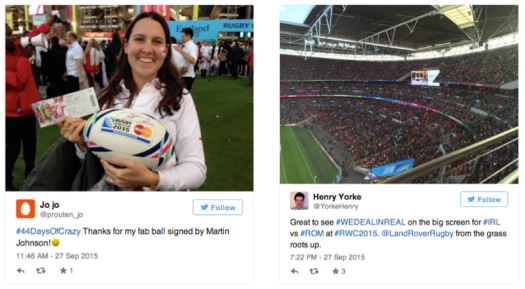
But how have brands capitalised on this massive sporting event? Four years in the planning, official sponsors of the tournament; MasterCard, Heineken, Land Rover, DHL, Societe Generale and Coca Cola (to name but a few), have competed for a slice of the oval shaped action. Sponsors haven’t missed a (tackle) trick, with each sponsor coining their own unique hashtag and encouraging fans to tweet along. Some of the most notable campaigns include; Heineken’s #itsyourcall, Land Rover’s #wedealinreal, Mastercard’s #44daysofcrazy and DHL’s #tackleman.
Here we can compare the share of voice for just some of these fiercely competitive official sponsors.
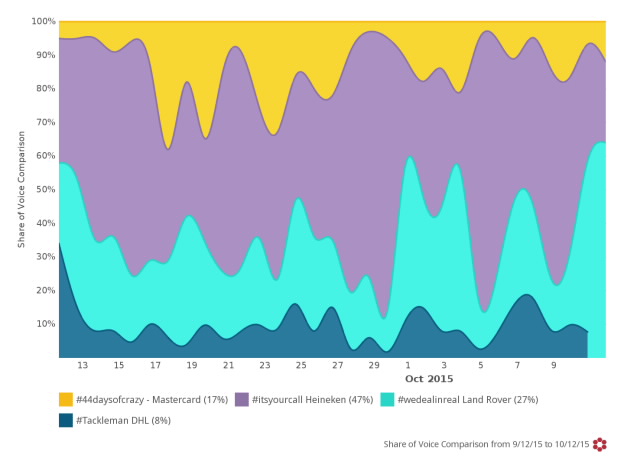 We can see that the majority of the conversation has been dominated by Heineken's #itsyourcall with 47% share of voice.
More interestingly, we can assess if customers are actually associating the hashtags with the brand themselves. Out of the 11,467 mentions of the #itsyourcall campaign, only 2,400 have explicitly mentioned Heineken, that’s around 20%.The disconnect is striking, and brings us to question the worthiness of the campaign for the brand.
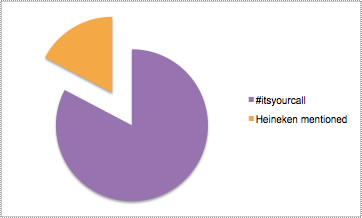
Overall then, we must question what impact, if any; do these hashtag campaigns have on increasing brand awareness?
The #unofficialsponsor
Interestingly, there are a number of unofficial sponsors with carefully orchestrated campaigns, which don’t specifically mention the RWC but cleverly associate themselves with the main event. These include:
O2 #weartherose
Samsung #schoolofrugby
Lucozade #onlyforthehomenations
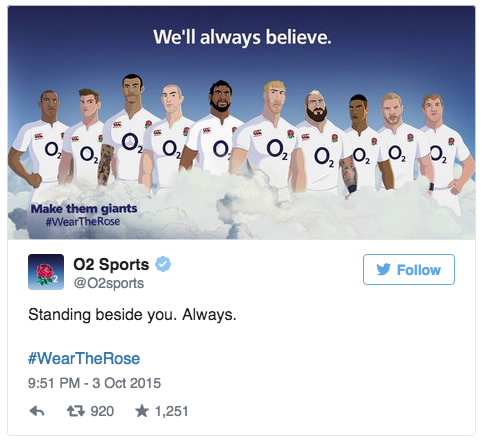
The winner is undeniably O2. Its #weartherose campaign is now synonymous with the tournament dominating the conversation…
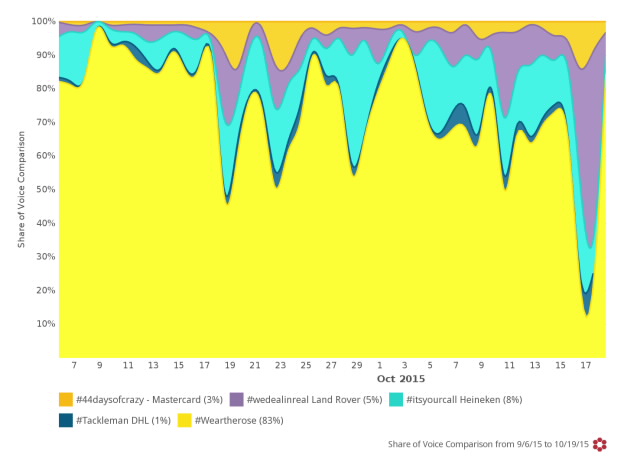
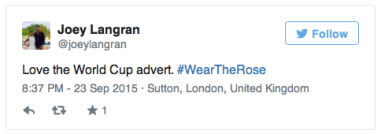
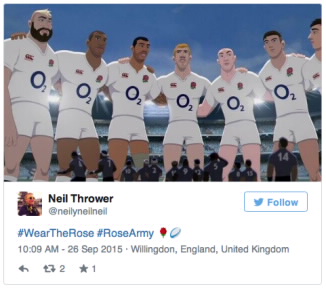
However, what with host England’s disappointing early exit from the tournament, many are criticising O2 for aligning themselves to the team and suggesting that global sponsorship partners are more savvy for not picking sides. But what choice did they have, O2 ARE team sponsors, always have been and isn’t that what a tournament is all about - picking sides?
The Billion Pound Game
RWC aside, how can other brands capitalise on unofficial sponsorship of major sporting events in the way O2 has? With 2016 Rio de Janeiro Olympics, Paralympics and Euro’s just around the corner as well as the Women’s Rugby World Cup and British and Irish Lions Tour in 2017, sponsorship deals have been agreed well in advance. However, could jumping on the #bandwagon be a more cost-effective and broader marketing strategy for those brands who haven’t signed an official deal? If so, it still remains to be seen whether backing a horse (like O2 and England) is a risky tactic rather than focusing on an event as a whole.
By Zoe Starr, Solutions Consultant at Crimson Hexagon.
PrivSec Conferences will bring together leading speakers and experts from privacy and security to deliver compelling content via solo presentations, panel discussions, debates, roundtables and workshops.
For more information on upcoming events, visit the website.
comments powered by Disqus